CFO vs Director of Finance: Which Does Your Business Need?
A director of finance runs the numbers; a CFO uses them to steer the business. Here is how to tell which one you need, and why many founders start with a fractional CFO.
- Director of finance
- Runs day-to-day finance: reporting, budgets, controls and the finance team
- CFO
- Owns financial strategy: cash, capital, pricing, investors and big decisions
- Growing companies
- Often need CFO-level thinking well before a full-time hire pays off

15+ years in finance: 100+ financial models built, €40m+ raised for clients, Forbes contributor and lecturer.
Short answer: a director of finance makes sure the numbers are right and on time. A CFO uses those numbers to decide where the business goes next. If your accounts are in order but you still guess at pricing, hiring and cash, you are missing the CFO part.
What a director of finance does
A director of finance (or finance director) runs the finance function. That usually means:
- Month-end close and management reporting
- Budgets and variance tracking
- Internal controls, payables and receivables
- Managing accountants and finance staff
- Preparing information for auditors and tax advisers
It is an operational, detail-heavy role. Done well, it gives you numbers you can trust.
What a CFO does
A CFO is a strategic partner to the CEO. The work looks forward:
- Cash flow forecasting and runway
- Unit economics: margins, CAC, LTV and payback
- Pricing and profitability by product or customer
- Funding, debt and investor relationships
- Scenario planning for hiring, expansion and downturns
The CFO asks "what should we do?" while the director of finance asks "what happened, and is it correct?"
Key differences at a glance
| Director of finance | CFO | |
|---|---|---|
| Focus | Accuracy, process, reporting | Strategy, capital, growth |
| Time horizon | Last month, this quarter | Next 12 to 36 months |
| Typical output | Reports, budgets, controls | Forecasts, scenarios, recommendations |
| Works closely with | Accountants, department heads | CEO, board, investors |
Which one does your business need?
Choose a director of finance when your books are messy, reporting is late, or you need someone to manage a team of accountants.
Choose a CFO when reporting is fine but you cannot answer questions such as: Which products actually make money? How many months of cash do we have? Can we afford to hire three people?
Many growing businesses need both, but not both full time.
Why founders start with a fractional CFO
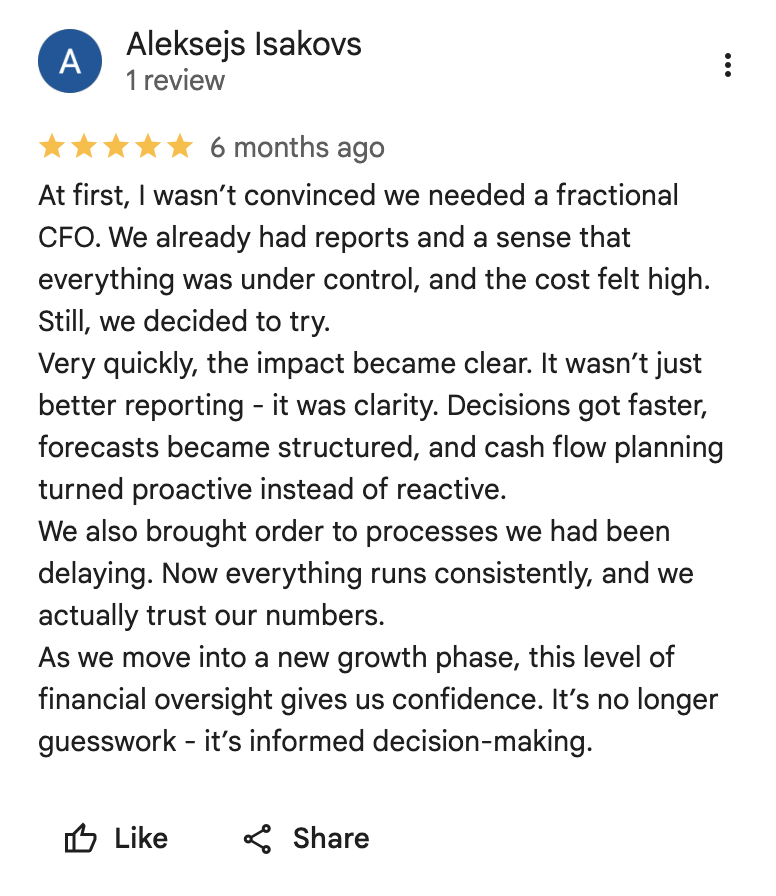
A full-time CFO is a six-figure commitment, which rarely makes sense for a company still scaling. A fractional CFO gives you the strategic layer for a fixed monthly fee, on top of your existing accountant or finance lead. You get profit, cash and the next move explained in plain English, without carrying a full-time salary.
If you are unsure where you stand, a short diagnostic is the quickest way to find the gap.
Book a CFO diagnostic call - 30 minutes, no pitch, a real CFO.
Related questions
Is a finance director the same as a CFO?
No. Titles overlap in practice, but a finance director usually manages the finance function, while a CFO sets financial strategy and advises the CEO on the decisions that shape the business.
Do I need a CFO if I already have a director of finance?
If your director of finance already forecasts cash, models scenarios and advises on pricing and funding, you may not. If they mainly produce reports, you probably still need strategic input.
Can a fractional CFO replace a director of finance?
Not for daily bookkeeping and controls. A fractional CFO sits on top of that work and turns it into decisions, which is why the two often work together.