Why Audit Financial Models: A Business Owner's Guide to Model Audits
Audit a financial model before you use it for a decision that is hard to reverse: a raise, a loan, an acquisition or a big hire. A model audit checks that inputs are sourced, formulas are consistent, the three statements balance and assumptions hold up. The reviewer must be independent of the person who built it.
- When to audit
- Before a raise, loan, acquisition or board-approved plan
- Three layers
- Mechanics, logic and assumptions, presentation
- Golden rule
- The reviewer did not build the model
- Bank guidance
- US agencies replaced SR 11-7 with new model risk guidance in April 2026

15+ years in finance: 100+ financial models built, €40m+ raised for clients, Forbes contributor and lecturer.
Why model audits matter to business owners
Most owners trust their financial model because they built it carefully and it has worked for a while. That confidence is the risk. This guide is for founders and owners who are about to raise, borrow, buy or hire on the strength of a spreadsheet, and want to know what a model audit is, when it is worth paying for, and what to check themselves first.
Why audit financial models: the risks and the regulatory picture
Audit a model because spreadsheet errors are silent. A broken formula rarely shows an error message. It returns a plausible number, and that number goes into a board deck, a loan application or a hiring plan.
Banks call this model risk: the chance of loss or a bad decision because a model is built wrongly, fed bad data or used for something it was not designed for. For SMBs the sources are the same:
- Input errors: outdated sales figures, miscoded costs, a currency mix-up.
- Weak assumptions: 20% monthly growth with no link to pipeline, capacity or marketing spend.
- Formula errors: broken links between tabs, references that shifted when a row was inserted.
- Misuse: a budget model reused as a fundraising model, with assumptions nobody revisited.
A well-known case comes from banking. JPMorgan's own task force report on the 2012 "London Whale" losses found that a key risk model ran on spreadsheets completed by hand, and that one formula divided by a sum instead of an average. As James Kwak summarized it, the error likely muted volatility by a factor of two and lowered the reported risk. Errors that make the numbers look better are the ones nobody goes looking for.
Regulators have recently restated how banks should manage this. On 17 April 2026 the Federal Reserve, OCC and FDIC issued revised interagency model risk guidance that supersedes the Federal Reserve's long-standing SR 11-7 and related OCC and FDIC guidance. It is aimed mainly at banks with more than $30 billion in assets, and it is principles-based rather than prescriptive. You are not bound by it. The principles still translate well to a 50-person company:
- Match the depth of review to how much the model matters.
- Validate before first use, then periodically.
- Compare model outputs with what actually happened.
- Make sure the reviewer is independent and able to challenge.
- Remember that buying a model or template does not outsource the risk.
Core components of a financial model audit
A model audit is not a quick scan for typos. It works through three layers, each with its own failure points.
1. Mechanical integrity. Do the formulas do what they appear to do?
- Inputs sit in one place, clearly marked, and are never typed into calculation rows.
- Formulas are consistent across each row; no column quietly uses a different formula.
- The balance sheet balances in every period, and the cash flow ties to the change in cash.
- No unintended circular references; external links are traced and documented.
- Units and periods are consistent: monthly vs annual, thousands vs units, VAT included or not.
2. Logic and assumptions. Does the model describe the business realistically?
- Revenue is driven by things you can observe: customers, orders, price, conversion, capacity.
- Costs scale with the right drivers; hiring matches the revenue plan.
- Working capital is modeled: stock, receivables and payables, not just profit.
- Backtesting: last year's version of the model is compared with actual results, and the gaps are explained.
- Sensitivity analysis: key inputs are flexed to show which ones move cash and runway most.
3. Presentation and use. Can a reader understand and trust it?
- A clear summary of outputs and scenarios.
- Assumptions documented with their source.
- A change log and a version that everyone uses.
- A clear statement of what the model is for, and what it is not for.
How deep you go depends on the stakes. A model behind a €2 million raise or a bank covenant deserves the full three layers. A simple monthly expense tracker does not.
Common pitfalls and how an audit catches them
The damaging errors are rarely dramatic. They hide inside formulas that look right and assumptions nobody has questioned for a year. ProsperSpark's 25-point Excel audit makes the point that most spreadsheet failures come from how files are built, edited, handed off and reused, not from Excel itself.
| Pitfall | What it looks like | How the audit catches it |
|---|---|---|
| Hardcoded override | A number typed over a formula to "fix" a month | Scan formula ranges for constants |
| Inconsistent formulas | One column uses a different formula from its neighbors | Row-consistency check |
| Shifted references | A copied formula points one row off | Trace precedents on first and last cells |
| Unbalanced balance sheet | Check cell hidden or ignored | Balance check in every period |
| Mixed periods | Annual costs added to monthly revenue | Units and period review |
| Optimistic drivers | Growth with no capacity or spend to support it | Backtesting and driver review |
| Missing working capital | Profit looks fine, cash runs out | Cash flow and balance sheet review |
| Version sprawl | Three "final" files in circulation | File and change control check |
AI-generated forecasts add a new version of the same risk. A well-formatted output is not evidence that the inputs, logic or training data fit your business. Treat AI-built models exactly like any other model: trace the inputs, test the logic, compare with actuals.
Integrating model audits into decisions and governance
An audit only reduces risk if its findings change how the model is used. A report that is filed and forgotten changes nothing.
Four practices make audits stick in a smaller company:
- A simple model policy: who can edit, which version is live, and what sign-off is needed before a model is used for a major decision.
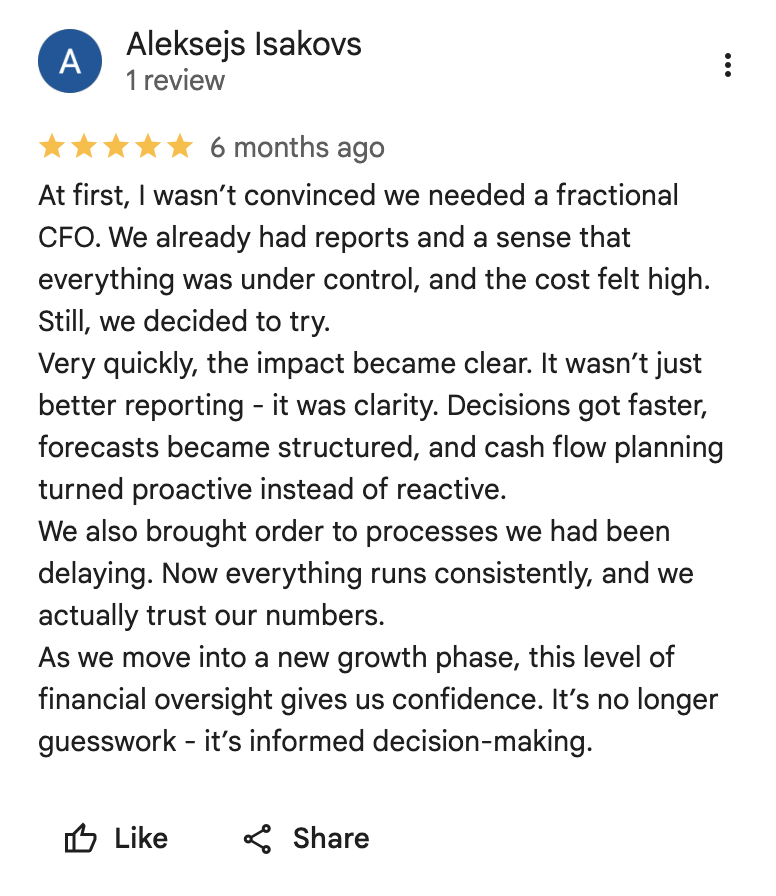
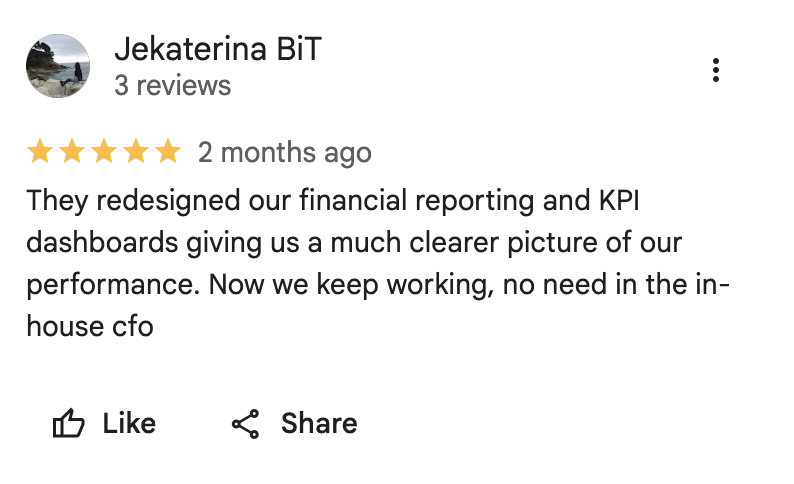
- An independent reviewer: someone who did not build the model. This does not need a new hire; a fractional CFO or external adviser can do it.
- Revalidation triggers: a new market, a new revenue stream, a large change in pricing or a handover between people.
- A quarterly check against actuals: even 30 minutes comparing forecast with results catches drift before it turns into a wrong decision.
| Role | Responsibility | Output |
|---|---|---|
| Model owner | Builds and maintains the model | Documented assumptions and change log |
| Independent reviewer | Tests mechanics, logic and assumptions | Findings and fixes |
| Finance lead or CFO | Interprets results for decisions | Risk-adjusted recommendation |
| Owner or board | Approves the model for a key decision | Sign-off or questions |
A self-check before you send a model anywhere
Run this before a model goes to an investor, bank or board. It does not replace an independent review, but it catches the embarrassing errors.
- Every input is in an inputs section, colored or labeled, with a source.
- No numbers are typed inside formula rows.
- The balance sheet balances in every period.
- Closing cash on the balance sheet equals closing cash in the cash flow.
- Revenue is built from drivers you can explain in one sentence each.
- Monthly and annual figures are not mixed.
- You have compared last year's forecast with last year's actuals.
- Downside scenario shows when cash would run out.
- The file name and version are clear, and only one version is circulating.
If you are building from scratch, our financial model template already separates inputs, calculations and outputs. Our guide to what makes a financial model credible to investors covers what reviewers on the other side of the table look for.
How we use model audits with clients
We treat a model audit as a decision tool, not a compliance step. When a client brings us a model, usually before a raise or a bank conversation, we start with the cash flow, not the formulas. If the model shows profit but cannot show when cash runs out under a downside case, it is not ready, however clean the formulas are.
Then we go through the three layers. The mechanical fixes are usually quick. The valuable findings sit in the assumptions:
- Unit economics: whether contribution margin per order or per customer supports the growth plan, or whether growth makes losses bigger.
- Working capital: whether stock and receivables are modeled, because they decide how much funding the plan really needs.
- Funding fit: whether the amount being raised or borrowed covers the plan with a buffer, given realistic timing.
- Reporting link: whether the model's structure matches the monthly management accounts, so it can be checked against actuals every month.
Often the outcome is not a different answer, but a clearer one: fewer assumptions, each one sourced, and a downside case the founder can defend in a meeting. Where the model needs a rebuild rather than a review, we do that as part of our financial model work, and before a raise we connect it to the wider fundraising process. We have built 100+ financial models for clients, and the ones that hold up in due diligence are the ones that were checked before anyone outside saw them.
Next step
If a model is about to drive a raise, a loan or a big hire, have it checked first. Book a free CFO diagnostic call and we will tell you whether your model is ready and what to fix.
Related questions
What is a financial model audit?
A financial model audit is an independent review of a spreadsheet model to confirm it does what it claims. The reviewer checks that inputs are sourced and separated from calculations, formulas are consistent, the balance sheet balances and cash ties out, and the assumptions are reasonable. The output is a written list of errors, risks and fixes.
When should I audit my financial model?
Before any decision that is expensive to reverse: fundraising, a bank facility, an acquisition, a major hire plan or a board-approved budget. Also after major structural edits or a handover between people. Models in regular use deserve a lighter check against actuals every quarter, so drift is caught early.
Can I audit my own financial model?
You can and should self-check the mechanics: totals, balance checks, hardcoded numbers in formulas. You cannot effectively challenge your own assumptions, because the same reasoning that produced them will approve them. For any high-stakes model, have someone independent review it: a finance lead who did not build it, a fractional CFO or a specialist firm.
What are the most common errors found in model audits?
Hardcoded numbers typed over formulas, formulas that change partway across a row, broken or shifted references after copying, mixed monthly and annual periods, circular references, a balance sheet that does not balance, and revenue assumptions with no link to capacity, pipeline or marketing spend. Most errors return a plausible number rather than an error message.
Do the bank model risk rules apply to small businesses?
No. The revised US interagency guidance issued in April 2026 is aimed mainly at banks with more than $30 billion in assets and is not enforceable as a standard. Its principles are still useful for any company: match the depth of review to the stakes, validate before first use, monitor against actuals and keep the validator independent.
Sources
Pages opened on 2026-10-15. Regulatory guidance summarized for business owners; it is not legal advice.
- KPMG: Model Risk Management, revised interagency guidance (Regulatory Alert, 2026)
- Consumer Financial Services Law Monitor: Federal banking agencies issue revised model risk management guidance for large banking organizations (April 2026)
- ProsperSpark: How to audit an Excel model, 25 checks
- The Baseline Scenario (James Kwak): The Importance of Excel, on the JPMorgan task force report