Ecommerce Cash Flow: How to Forecast and Manage It
An ecommerce business can show a profit every month and still miss payroll. The reason is timing: you pay suppliers, freight and duties weeks or months before the customer's money turns into cash you can spend, and you pay for ads before the order even arrives.

15+ years in finance: 100+ financial models built, €40m+ raised for clients, Forbes contributor and lecturer.
Why profitable stores still run out of cash
An ecommerce business can show a profit every month and still miss payroll. The reason is timing: you pay suppliers, freight and duties weeks or months before the customer's money turns into cash you can spend, and you pay for ads before the order even arrives.
This guide takes a different route from a general overview. We build one worked example, a 13-week cash forecast for a small DTC brand, break it with a real problem, and then show which levers fix it and by how much. You can copy the structure into your own sheet in an afternoon.
If you want the concept explained first, read how a 13-week cash flow forecast works. If you want the template, grab the 13-week cash flow template.
The example store and its assumptions
Meet a DTC brand selling one product line. Everything below is illustrative, so replace it with your own numbers.
| Assumption | Value |
|---|---|
| Opening cash | 35,000 |
| Week 1 revenue | 30,000, growing 2% a week |
| Payment fees | 3% of revenue, cash arrives in the same week |
| Ad spend | 30% of revenue, paid weekly |
| Shipping and fulfilment | 8% of revenue |
| Fixed costs (payroll, software, rent) | 9,000 a week |
| Purchase order A (70,000) | 30% deposit in week 2, 49,000 balance in week 7 |
| Purchase order B (80,000) | 30% deposit in week 6, 56,000 balance in week 11 |
| Minimum cash buffer | 15,000 (about one week of outgoings) |
The weekly formula is simple: closing cash = opening cash + revenue after fees − ads − shipping − fixed costs − supplier payments. Nothing in it is exotic. What makes it useful is that the two purchase orders land as lumps on specific weeks, which a monthly P&L would smooth away.
What the forecast shows
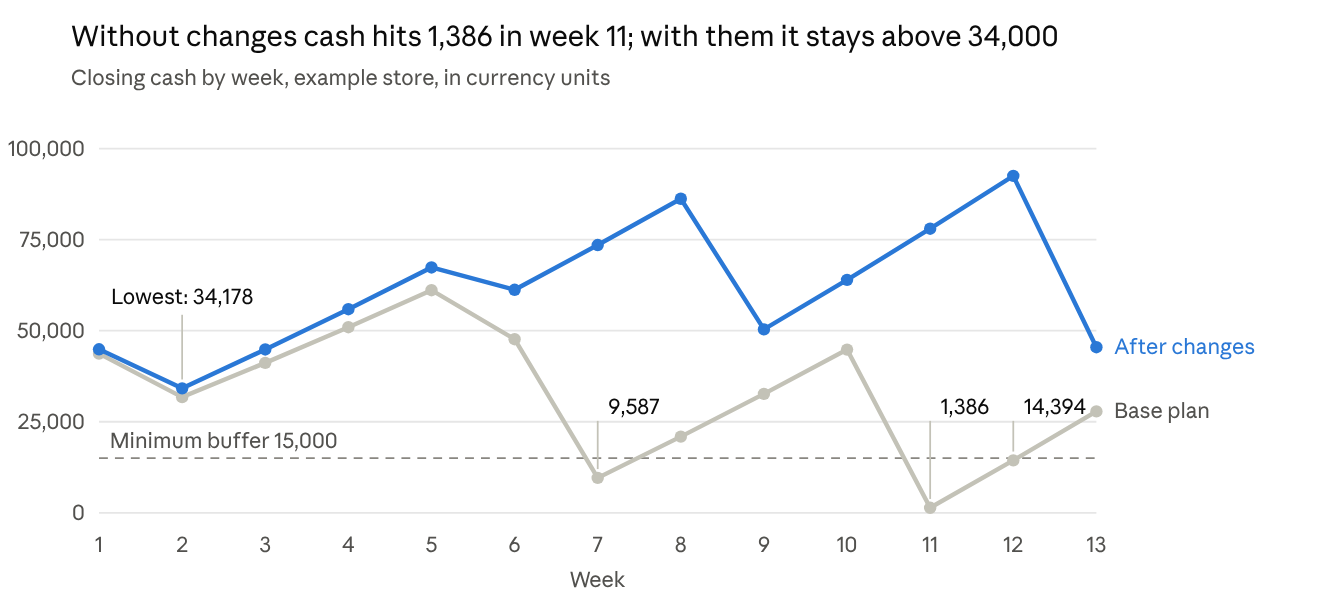
Illustrative model built from the assumptions above · 13 weeks
The business is growing and never loses money on a weekly basis, yet cash falls below the buffer in weeks 7, 11 and 12. The dips follow the weeks when a supplier balance falls due, right after revenue was already spent on ads and deposits. A monthly report would show a healthy month and hide all three.
Week 11 is the dangerous one: with 1,386 left, a late payout or a single unplanned expense means missed payments.
Which levers fix it, and by how much
We tested each lever on its own against the base plan, then combined them. The figure to watch is the lowest weekly closing cash.
| Scenario | What changes | Lowest closing cash |
|---|---|---|
| Base plan | Nothing | 1,386 (week 11) |
| Cut ad spend | Ads from 30% to 26% of revenue | 15,989 |
| Longer supplier terms | Both balances paid two weeks later (weeks 9 and 13) | 27,842 |
| All changes together | Ads at 26%, later balances, and a smaller PO B deposit (18,000 deposit, 62,000 balance) | 34,178 (week 2) |
Two honest caveats. Paying suppliers later moves the cash out, it does not remove it: the week 13 balance still has to be funded, which is why closing cash in the last week is lower in the improved case. And cutting ads only helps if revenue holds, so test the cut on your lowest-ROAS campaigns first and check your true ROAS before trimming.
For more on what ties cash up in stock, see how inventory kills cash in DTC businesses.
How to build your own 13-week forecast
-
Start from real cash. Use today's bank balance, not the book balance, and add any payout balances you are sure will land.
-
List every cash event by week. Payment-processor payouts, marketplace settlements, ad invoices or card charges, supplier deposits and balances, freight, duties, VAT, payroll, loan repayments, tax.
-
Forecast receipts from orders, not from the P&L. Take expected orders, subtract refunds and fees, then apply your real payout delay for each channel.
-
Put purchase orders on the calendar. Every deposit and balance gets the actual week it is paid, including freight and duties on arrival.
-
Set a minimum buffer of roughly one week of outgoings, and mark any week that ends below it.
-
Run three cases: base, a downside with revenue 15% lower, and an upside. Decide in advance what you will do if the downside happens, such as delaying a reorder or pausing a campaign.
The 13-week cash flow template has this layout ready to fill in.
A 30-minute weekly routine
A forecast only works if it is updated. Once a week, ideally Monday morning:
-
Replace last week's forecast with actual bank movements.
-
Note the biggest variance and why (late payout, higher refunds, ad overspend).
-
Roll the forecast forward one week so it always covers 13 weeks.
-
Check the lowest week. If it is under your buffer, pick a lever from the table above and act now, while it is still cheap.
-
Confirm supplier payments due in the next four weeks and who approves them.
Over a few months the variances show where your assumptions are weakest, and the forecast gets steadily more accurate.
FAQ
Why 13 weeks? It covers one full quarter, which is long enough to see a purchase order cycle from deposit to balance and short enough to forecast with reasonable accuracy.
Is cash flow the same as profit? No. Profit counts a sale when it happens; cash flow counts money when it moves. Inventory, ad prepayments and payout delays all create gaps between the two.
How much cash buffer do I need? A common starting point is one to two weeks of total outgoings. Brands with long supplier lead times or seasonal peaks usually hold more.
What is the fastest way to improve cash? Usually supplier terms and ad efficiency, because they change timing and spend without needing new sales. See also the cash conversion cycle for how stock days drive this.
Should I fund a gap with debt? Only after the cheaper levers are used. If you do, compare the options in debt vs equity growth capital.
Next steps
Build your first 13-week forecast this week, using the template, and find your lowest week. If you would rather have it built and maintained for you, see our cash forecasting service or fractional CFO for ecommerce. To see where your business stands today, take the free health check.
Written from our own CFO engagements: how we scope retainers, what we deliver in the first 30 days, and what founders actually ask on diagnostic calls. Third-party studies are cited only when we can link them.
- How we scope engagements – our published scoping factors
A free 30-minute call with a senior CFO. No sales pitch – just a clear read on where your money is and what to do next.